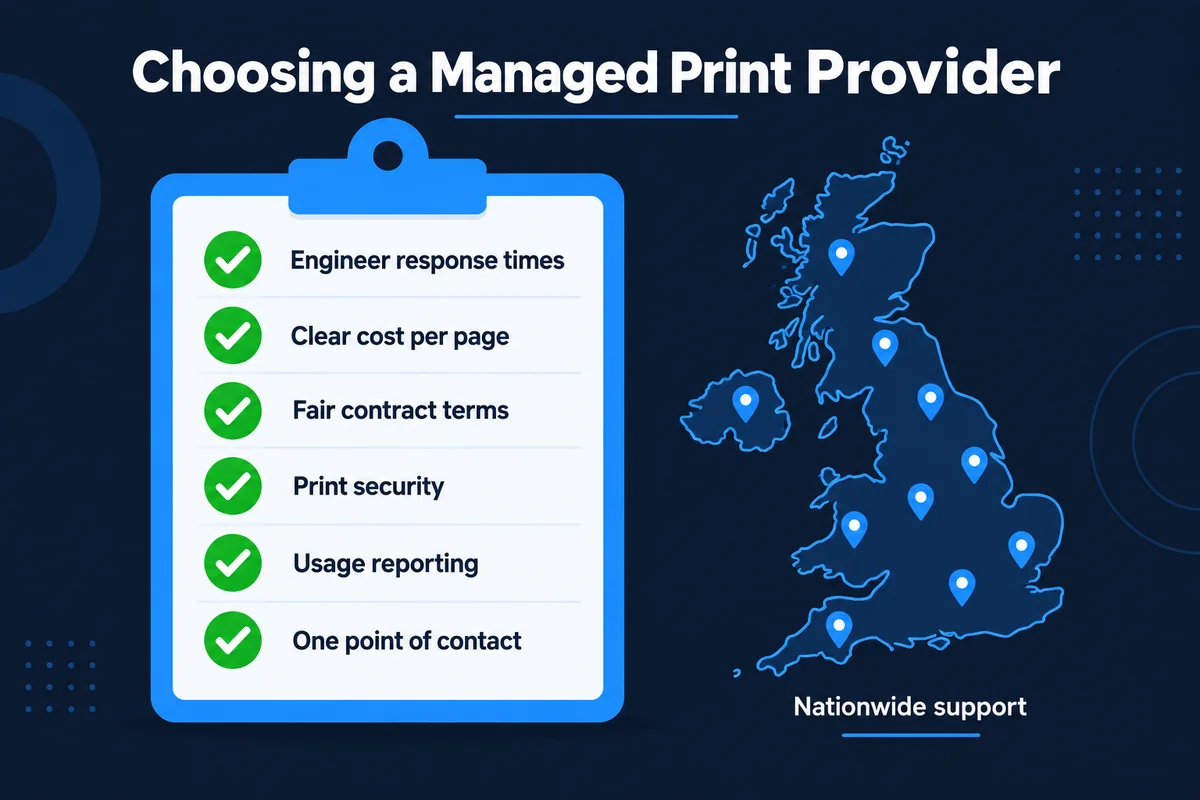
To choose a managed print provider, compare far more than the price per page. Ask how quickly an engineer will be on site, exactly what is included, how prices rise each year, whether there are minimum volumes, what the contract length and exit terms are, how devices are secured, and whether they audit your printing before quoting.
A managed print contract usually runs for several years, so the provider you choose matters far more than the headline price on the first quote. Pick well and printing becomes something nobody in the business thinks about. Pick badly and you are locked into slow repairs, confusing bills and a contract that is hard to leave. This guide sets out the questions to ask, what good answers sound like, and the red flags to watch for before you sign. If you are new to the idea, start with what MPS stands for.
What questions should you ask a managed print provider?
1. How quickly will an engineer be on site?
This is the question that matters most when something goes wrong. Ask exactly what the quoted response time means: a phone call back, a remote fix, or an engineer physically on site. Ask whether it is measured to the engineer arriving or to the fault being fixed, because the two can be very different, and whether it applies to every one of your locations, not just those near the provider's base. Slow repairs are the most expensive part of printing, as our guide to the real cost of printer downtime explains.
2. What exactly is included?
A proper managed print service should include devices, toner and consumables, parts, labour, engineer call-outs, remote monitoring and reporting. Ask what is excluded. Paper, staples, finishing units and certain parts are common exclusions, and they are better discovered now than on an invoice.
3. What is the cost per page for mono and colour?
Ask for mono and colour page rates in writing, and check how A3 pages are charged, as many contracts count them as two clicks. A clear cost per page is the foundation of a predictable print budget.
4. Are there minimum volumes?
Some agreements charge for a minimum number of pages each month or quarter, whether you print them or not. If your printing falls, for example because more of the team works from home, you keep paying for pages you no longer use. Make sure any minimum reflects your real usage.
5. How do prices change over the contract?
Ask whether page rates are fixed for the term or rise each year, and if so by how much. A small annual increase compounds over a five-year agreement, so if prices can rise, ask for the increase to be capped in writing. For more on this, read how to avoid hidden printer contract costs.
6. How long is the contract, and what happens at the end?
Check the length of the agreement, the notice period, whether it renews automatically, and your options at the end of the term. If the devices are leased, understand how the lease and the service agreement fit together. Our guide on what happens at the end of a copier lease covers the details.
7. Will you audit our current printing first?
A provider that quotes without measuring how you print is guessing. A good one starts with a print audit to understand your devices, volumes and costs, then recommends a fleet that fits. It is the best sign that the recommendation is built around you rather than around a sales target.
8. How do you keep our devices and documents secure?
Modern printers are networked computers that store and send documents. Ask about firmware protection, secure print release so confidential documents are not left on trays, user authentication, and how hard drives are wiped when devices are removed. See our article on HP Wolf Security for what built-in protection looks like.
9. What reporting will we get?
You should be able to see what is printed, where, in colour or mono, and what it costs. Regular reporting lets you spot waste, right-size your fleet and hold the provider to account against a clear baseline.
10. Who do we call when something goes wrong?
A single point of contact who knows your account is worth a great deal. Ask whether support is handled in-house or passed to third parties, and whether the provider also understands the IT side, such as drivers, networks and cloud printing, since that is where many printing problems start.
What else should you check?
- References and case studies – ask to speak to existing customers of a similar size or sector, and look at published case studies and reviews.
- Flexibility as you change – how the agreement handles new sites, office moves, hybrid working or a change in headcount.
- Sector experience – providers who already support businesses like yours understand the security and volume demands involved.
- Sustainability reporting – whether they can report on paper, energy and consumables to support your environmental goals.
What are the red flags when choosing a print provider?
- Vague response times – "prompt" or "as soon as possible" rather than a clear on-site commitment.
- A quote without an audit – a price produced before anyone has looked at your printing.
- High minimum volumes – paying for pages you do not print.
- Automatic renewal with a long notice period – easy to miss, hard to escape.
- Uncapped annual increases – rates that can climb every year without a limit.
- Pressure to sign quickly – a good deal will still be a good deal next week.
Should you choose a local or national print provider?
What matters is not where a provider is based but how quickly its engineers reach every one of your sites. A small local firm may be quick around the corner and slow everywhere else, while some national operators are stretched thin across the whole country. If you have more than one location, ask for the on-site response commitment for each of them, in writing.
Why businesses choose Mastercopy
Mastercopy has managed print for UK businesses since 1989. We are an authorised HP partner with our own engineers, and we are built around the questions above:
- Same-day on-site engineer cover nationwide – from our Teesside base to sites across the UK.
- A free print audit first – we measure before we recommend, and the report is yours to keep.
- Clear, written costs – devices, toner, parts, labour and call-outs on one predictable bill.
- Print and IT under one roof – managed print, leasing and IT support from one team.
Frequently Asked Questions
What should I look for in a managed print provider?
Look for genuine on-site engineer response times, a clear cost per page with nothing hidden, contract terms you understand, strong device and document security, proper usage reporting, and a single point of contact. A good provider will also start with an audit of your current printing rather than a quote.
What should a managed print contract include?
A managed print contract should clearly include the devices, toner and consumables, parts, labour and engineer call-outs, remote monitoring, and reporting, with mono and colour page rates set out in writing. It should also state the contract length, any minimum volumes, how prices change over time, and what happens at the end of the term.
What SLA response time should I expect from a managed print provider?
Expect a written commitment to get an engineer on site within a set time, not just a call back, and check whether it is measured to the engineer arriving or to the fault being fixed. Make sure it applies to every one of your sites and is delivered by the provider's own engineers. Mastercopy provides same-day on-site engineer cover nationwide.
What are the red flags when choosing a print provider?
Watch for vague response times, high minimum monthly volumes, automatic renewals with long notice periods, uncapped annual price increases, quotes given without looking at your current usage, and pressure to sign quickly. Any of these can make a low headline price expensive over the life of the contract.
How long are managed print contracts?
Managed print agreements in the UK commonly run for three to five years, often aligned with the lease on the devices. What matters more than the length is knowing the notice period, whether the contract renews automatically, and what the end-of-term options are.
What happens at the end of a managed print contract?
Depending on the agreement, you can usually renew, upgrade to new devices or end the service. Check the notice period and whether the contract renews automatically, how and when devices are collected, and that their hard drives are securely wiped before they leave your premises.
Is a local or national print provider better?
What matters is how quickly an engineer can reach every one of your sites. A local provider may be responsive nearby but struggle with other locations, while some national providers are slow everywhere. Look for a provider that offers same-day on-site cover across all your sites. Mastercopy provides same-day on-site engineer cover nationwide from its Teesside base.
Comparing providers? Call Mastercopy on 01642 750404 or email sales@mastercopy.co.uk and put these questions to us.