Key takeaways
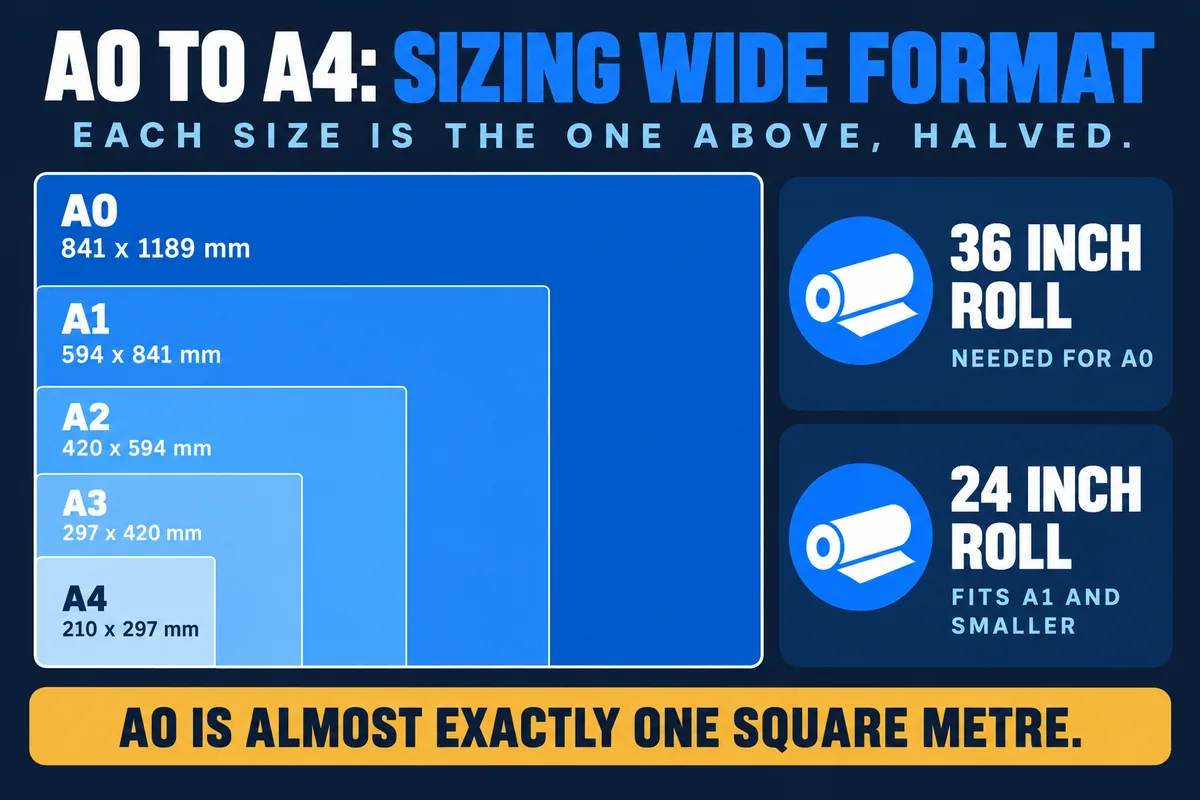
- A0 is 841 by 1189mm, almost exactly one square metre, and each size below it is the one above folded in half.
- A wide-format printer is sized by roll width, not sheet size: A0 needs 36 inch, A1 fits 24 inch.
- Plotter and wide-format printer now mean the same thing. Pen plotters have not been sold for decades.
- Wide-format running cost is driven by ink coverage and media, not by a per-page click charge.
- Pigment ink suits drawings that leave the office; dye ink suits indoor display work.
- An integrated scanner only earns its place if you genuinely receive or archive paper drawings.
A0 measures 841 by 1189mm, and a printer that can produce it needs a 36 inch roll. If almost everything you print is A1 or smaller, a 24 inch machine will do, and it will cost less and take up far less room. Getting that one decision right matters more than any specification on the brochure.
Wide format is the part of the print estate people buy by guesswork, usually because it is bought once every seven or eight years and nobody remembers the last time. Here is how to size it properly.
What the A sizes actually are
The A series is defined by ISO 216. A0 is one square metre, and every size below it is the previous sheet halved along its long edge. That is why a drawing scales between sizes without distorting, and why a drawing issued at A1 prints correctly at A3 for a meeting.
| Size | Millimetres | Short edge | Minimum roll width |
|---|---|---|---|
| A0 | 841 × 1189 | 841mm | 36 inch (914mm) |
| A1 | 594 × 841 | 594mm | 24 inch (610mm) |
| A2 | 420 × 594 | 420mm | 24 inch (610mm) |
| A3 | 297 × 420 | 297mm | Office MFD handles this |
| A4 | 210 × 297 | 210mm | Office MFD handles this |
The column that decides your purchase is the last one. A roll-fed machine is specified by the width of media it accepts, so a "24 inch" device prints anything up to 610mm across and any length you like. A1 fits comfortably. A0 does not.
So do you need A0, or are you buying it out of habit?
This is the question worth being honest about, because the gap between a 24 inch and a 36 inch machine is significant in both purchase cost and floor space.
Count what you issued over the last twelve months rather than what you think you print. In most architectural and engineering practices we audit, the overwhelming majority of output is A1, with occasional A0 for a presentation set or a site plan. If that is your pattern, a 24 inch machine plus sending the handful of A0s to a bureau is usually the cheaper answer over the life of the device.
Go to 36 inch when A0 is routine rather than exceptional, when you print to the full width regularly, or when turnaround matters enough that an outsourced sheet is a problem.
Plotter or printer? The word does not matter any more
A plotter originally drew with physical pens held on a moving arm, which is why producing a drawing is still called plotting and why CAD software still has a Plot command. Those machines have not been sold in decades.
Everything current is an inkjet printer that takes wide media. The only real distinction is whether the unit prints only, or has a scanner on top for copying and digitising wide originals.
What actually drives the running cost
This is where wide format behaves differently from the rest of your fleet, and where budgets go wrong.
An A3 office multifunction is normally billed per click: a page costs what a page costs, whether it carries one line or a full-page photograph. Wide format is not like that. Cost is driven by how much ink lands on the media, plus the media itself.
- A CAD line drawing on bond paper is mostly white space and uses very little ink.
- A full-bleed colour render, a site photograph or a shaded map on coated or satin stock uses a great deal more.
- Media is a real line item. Plain bond, coated, satin, polypropylene and film differ substantially per square metre.
Two practices printing the same number of A1 sheets can therefore have very different monthly costs. That is precisely why we scope before quoting rather than pricing from a sheet count, and it is the same discipline we apply in a print audit for the office fleet.
Dye or pigment ink?
Default to pigment for technical work. Pigment particles sit on the surface of the media and resist water, UV and handling, which matters for anything rolled up, carried to site, unrolled in the rain and marked up. Planning submissions and record drawings also benefit from the longer fade resistance.
Dye ink penetrates the media and gives slightly richer, smoother colour, which suits indoor display graphics and presentation work that will not leave the building.
Do you need wide-format scanning?
Only if paper drawings genuinely come into the building, or you are sitting on an archive you want digitised.
Plenty of practices now work entirely in PDF and have not scanned an A1 in years. If that is you, a scanner adds purchase cost, footprint and another component to maintain for no return. If you do hold a drawing archive, scanning it is usually a one-off project better handled as a project than by buying a machine, and the output belongs in a system that can index and retrieve it rather than in a folder tree.
Where it should sit, physically
Wide format is routinely underestimated on space. A 36 inch machine is typically over a metre and a half wide, needs clearance in front for prints to drop into the catch basket, and may need access behind for sheet media. A floor-standing unit on its own stand is usually easier to accommodate than a benchtop model, because a benchtop still needs a long, strong bench.
It also wants to be somewhere people can reach without walking a wet A0 across an open-plan office.
Buy, lease or outsource?
Wide-format volume is project-driven. It spikes around a submission and goes quiet in between, which makes it harder to size a fixed monthly cost than it is for office print.
- Buying suits a stable, modest volume where the device will be kept a long time.
- Leasing spreads the capital and usually bundles service and consumables, which smooths the lumpiness.
- Outsourcing the occasional A0 is genuinely the right answer for some practices and we will say so.
As an authorised HP partner we supply the DesignJet range alongside the office fleet, so wide format can sit on the same support arrangement as everything else rather than being the one device nobody owns. If you are weighing up the office side of that too, our guide to owning versus leasing covers the same trade-off for A3 and A4 devices.
Sources: paper dimensions and the halving relationship are defined by ISO 216. Roll widths of 24 and 36 inches are the long-standing industry conventions that correspond to A1 and A0 short edges. Last reviewed 23 October 2026.