Key takeaways
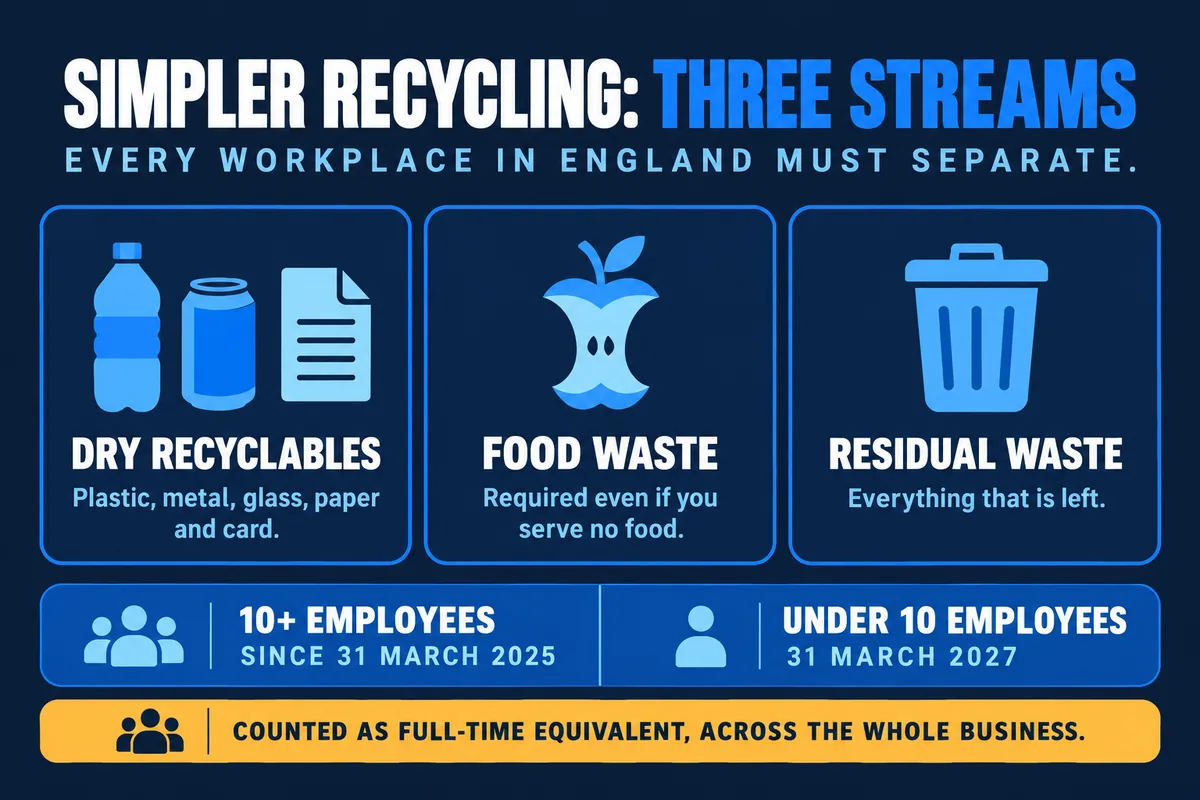
- Every workplace in England must separate waste into three streams: dry recycling, food waste and residual waste.
- Dry recycling means plastic, metal, glass, paper and card, with paper and card kept apart from the rest unless the collector assesses otherwise.
- Workplaces with 10 or more full-time equivalent staff have been in scope since 31 March 2025.
- Workplaces with fewer than 10 FTE have until 31 March 2027, and the extension is automatic with nothing to register.
- Food waste must be collected even where no food is served, which is the requirement small offices most often miss.
- The FTE threshold counts the whole business, not each site, and excludes volunteers, contractors and the self-employed.
Every workplace in England now has to separate its waste into three streams: dry recyclables, food waste and everything else. Larger workplaces have been in scope since 31 March 2025. If you employ fewer than 10 full-time equivalent people, you have until 31 March 2027, and nobody will remind you.
This is not a recycling target or a voluntary scheme. It is a requirement on how waste is presented for collection, and the practical work is mostly about bins, contracts and habits rather than anything complicated.
What exactly has to be separated?
Government guidance sets three streams:
| Stream | What goes in it | Notes |
|---|---|---|
| Dry recyclables | Plastic, metal, glass, paper and card | Paper and card separate from plastic, metal and glass, unless your collector completes a written assessment that separate collection is not practical |
| Food waste | All food waste | Required even if the workplace does not serve food |
| Residual waste | Everything that is not in the other two | The aim is for this to shrink |
You can run separate bins for each, or separate the waste before collection. The rule is about what arrives at the collection point, not about how many containers sit under the desks.
Which date applies to us?
One threshold decides it, and it is measured in a way that catches people out.
- 10 or more full-time equivalent employees – in scope since 31 March 2025.
- Fewer than 10 full-time equivalent employees – in scope from 31 March 2027.
Three details matter. The count is full-time equivalent, so part-time staff count as a fraction of their pro-rated hours rather than as whole people. It is counted across the whole business, not per site, so a firm with three small branches is usually over the threshold and has been in scope for more than a year. And volunteers, contractors and self-employed workers do not count.
The micro-firm extension is automatic. There is nothing to register and nothing to apply for, which also means no letter will arrive in March 2027 to tell you it has ended.
The bit small offices miss
Food waste. The guidance requires it to be collected even where the workplace does not serve food, on the straightforward basis that people bring lunch in and throw the remains away at work.
For an office of six people with no kitchen beyond a kettle, this is the only genuinely new thing on the list. Paper and card already have a bin in most buildings. Food waste usually means a new container, a new collection and a conversation with the landlord if the building has shared facilities. It is the item worth sorting first, because it is the one with a lead time.
What you actually have to do
- Work out your FTE number across the whole business, so you know whether your date was 2025 or is 2027.
- Check what your current collector already does. Many commercial contracts were changed in 2025 and you may be most of the way there without knowing.
- Arrange the missing streams, food waste usually being the gap, with a carrier on the Public Register of Waste Carriers, Brokers and Dealers.
- Keep the paperwork. Your duty of care to ensure waste is handled safely, securely and legally does not pass to the collector when the bin is emptied.
- Label the bins properly and put them where the old single bin was. Compliance fails at the desk, not in the contract.
Confidential paper is a separate duty
Simpler Recycling treats confidential paper as paper. Data protection does not. Those two obligations have to be satisfied at once: securely destroyed, and then recycled.
A shredder next to a general waste bin satisfies neither cleanly, because shredded paper thrown in with residual waste is recyclable material going to disposal, and a desk shredder produces strips that are not always adequate for sensitive material. Secure destruction with a certificate, going on to a paper recycling stream, covers both. If you handle personal data at any volume this is worth checking before the deadline rather than after.
The part you can actually reduce
Everything above is a collection arrangement. The one part of it you control directly is how much paper you generate in the first place.
In our experience of running print audits, two changes do most of the work: default duplex printing, and secure release so documents only print when somebody is standing at the device. Together they typically remove between a fifth and a third of office print volume, because a large share of what offices print is never collected. That reduces the paper stream, the confidential destruction cost and the print cost in one move.
It is the only lever here that saves money rather than adding a line to the waste bill, which is why it is worth pulling before March 2027 rather than after. Our guide to sustainable printing covers the rest.
Sources: the three waste streams, the collection rules, the full-time equivalent threshold and the 31 March 2027 micro-firm date are taken from the government's guidance on Simpler Recycling, workplace recycling in England and the Simpler Recycling policy update. Mastercopy does not collect or dispose of waste. Last reviewed 8 October 2026.