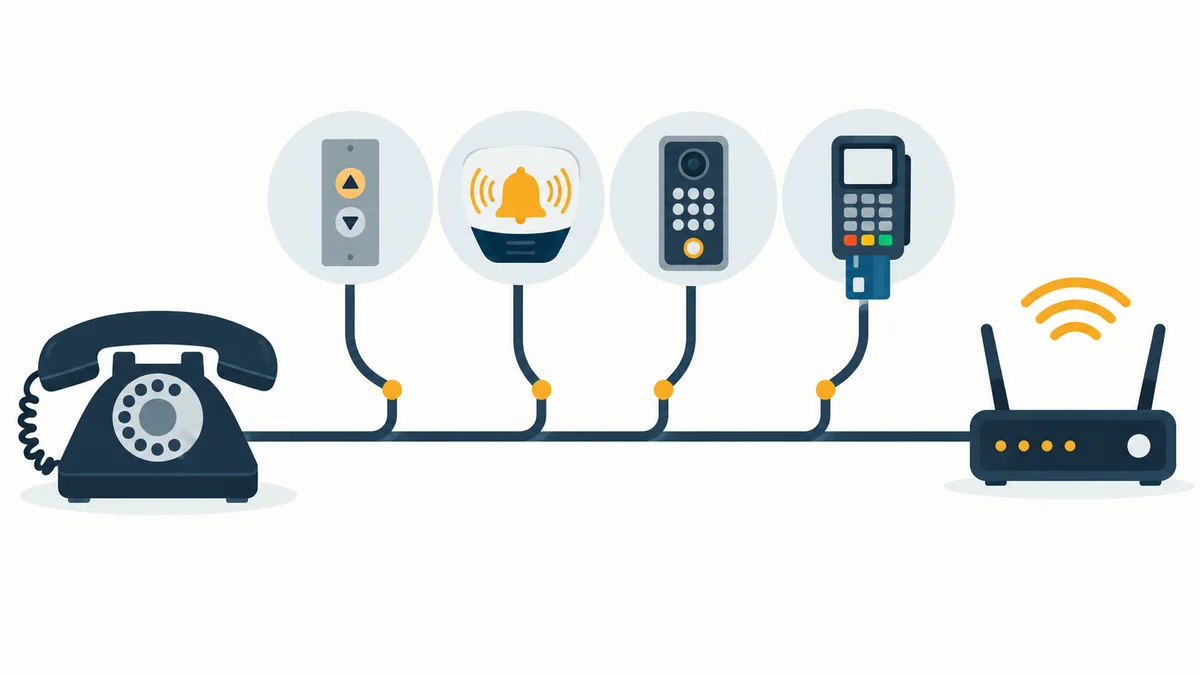
The PSTN and ISDN networks are switched off on 31 January 2027, and every remaining analogue line in the UK moves to digital. The phone system is the obvious part and usually the easy part. The risk sits in the devices nobody remembers are on a phone line: the lift alarm, the intruder alarm dialler, the door entry panel and the card machine.
This is not a proposal or a consultation. Government guidance and every major provider are working to the same date, and the industry has been closing off new analogue orders for some time. What remains is the part each business has to do for itself.
What is actually being switched off?
Two things. The Public Switched Telephone Network, the copper network that has carried analogue voice for over a century, and ISDN, the older digital service that a great many business phone systems still sit on. Broadband delivered over those lines goes with them.
What replaces them is voice carried over an internet connection. Providers market it as VoIP, Digital Voice or All-IP telephony, and for most offices the day-to-day experience is similar or better. Numbers carry across. Handsets are usually replaced. If a business only used its lines for talking to people, this would be a procurement exercise and nothing more.
What else is sitting on those lines?
Almost every building has analogue lines doing work that nobody thinks of as telephony. In our experience the usual list runs:
- Lift emergency alarms – the button in the lift car that has to reach a monitoring centre, which is a legal safety requirement rather than a convenience.
- Intruder and fire alarm diallers – the link that tells a monitoring station something has happened.
- Door entry and gate systems – often on their own forgotten line.
- Card payment terminals – particularly older countertop units in retail and hospitality.
- Fax lines, franking machines and EPOS units – still in service more often than people expect.
- Telecare and assistive devices – critical in care settings and in any building with residents.
The important point, and it comes straight from the official guidance, is that communications providers do not know which devices are connected to their network. They can see that a line exists. They cannot see that it terminates in a lift shaft. No letter is coming that lists your devices, because nobody holds that list. It has to be built.
Why does a power cut matter now when it did not before?
An analogue line drew its power from the exchange. That is why a corded phone still worked when the building lost electricity, and why it was a reasonable place to put a lift alarm.
A digital line depends on your router, your network and your mains supply. Lose power and the line goes with it, unless battery backup or a mobile-based alternative has been designed in. For an office phone that is an inconvenience. For an emergency alarm in a lift, or a fire panel's route to a monitoring centre, it is a safety question that needs answering before the line changes, not afterwards.
What should a business do before January 2027?
The audit is free, it only costs time, and it is the whole job. Migration is straightforward once you know what you are migrating.
- List every line the business pays for. Start with the bills rather than the building. Most organisations find lines they had forgotten they were paying for, which is worth the exercise on its own.
- Trace what each line is connected to. Walk the building. Check the lift motor room, the alarm panel, the comms cupboard, the reception desk and the back of the till.
- Check the devices that are not phones. For each one, ask the company that maintains it whether the unit is compatible with a digital line, needs an adaptor, or needs replacing. Lift and alarm companies are the ones to contact early.
- Decide what happens in a power cut. For every safety-critical device, agree the answer in writing before the line moves.
- Book the changeover before the queue forms. Every UK business shares this deadline and the same pool of specialist engineers.
Why leaving it until late 2026 is the expensive option
Nothing about this is technically difficult. The difficulty is that it is not one project, it is several small ones owned by different suppliers, and the ones that matter most are the ones you do not control. A lift engineer's diary in the final quarter before a national deadline will not have much room in it.
There is also a quieter risk. A business that migrates its lines without auditing its devices will not usually discover the problem on the day. It will discover it the first time someone presses the alarm button in the lift, which may be months later.
How this fits the rest of your IT
For most of our clients this lands in the same conversation as the rest of their infrastructure, because the answer usually involves the network rather than the phone system. If you are already planning around Windows Server 2016 end of life in January 2027, the two deadlines fall within weeks of each other and are worth planning together rather than twice.
We are not a telecoms reseller and we will not try to sell you lines. What we do is the part that tends to go undone: working out what you actually have, what depends on it, and who needs to be called. Where the answer is a telephony migration we will say so and point you at it. Our managed IT support clients get this as part of the service.
Frequently asked questions
When is the PSTN switch-off?
31 January 2027. On that date the Public Switched Telephone Network and ISDN are retired across the UK and every remaining analogue line moves to digital, IP-based service. The date is industry-led rather than a piece of legislation, but it applies to every provider, so there is no version of this where a business opts out.
What is being switched off, exactly?
The copper telephone network that carries analogue voice, and ISDN, the older digital service many phone systems still use. Broadband delivered over those lines is affected too. What replaces them is voice carried over an internet connection, sold as VoIP, Digital Voice or All-IP telephony depending on the provider.
Which devices other than phones are affected?
This is the part that catches businesses out. Lift emergency alarms, intruder and fire alarm diallers, door entry systems, card payment terminals, fax lines, franking machines, CCTV links, EPOS units and telecare devices all commonly sit on analogue lines. Government guidance is explicit that providers do not know what is connected to a given line, so nobody will tell you. Finding them is the customer's job.
What happens to a digital phone line in a power cut?
It stops working, unless something has been put in place to keep it running. An analogue line drew power from the exchange, so a corded handset worked when the building lost power. A digital line depends on your router and your electricity. For a lift alarm or a fire panel that is not an inconvenience, it is a safety issue, so battery backup or a mobile-based alternative has to be part of the plan.
Can we just wait until closer to the date?
You can, but the work is not evenly spread. Every UK business is facing the same deadline and the same pool of engineers, and the devices that need attention are the ones needing a specialist visit, such as a lift engineer or an alarm company. The audit itself costs nothing but time and can be done now. Leaving the remediation to the final quarter is how a deadline becomes an outage.
Will our existing phone numbers change?
Generally no. Numbers can normally be carried across to the digital service, which is why most of the attention goes on handsets and numbers rather than on the devices quietly sharing the line. The number is rarely the hard part of this project.
Who is responsible for sorting it out?
The business that holds the line. Your communications provider will migrate the line itself, but responsibility for knowing what is plugged into it, and for making sure a lift alarm still reaches a monitoring centre afterwards, sits with you. That is why an audit ahead of the date matters more than the migration does.
Sources: the switch-off date and the warning about connected devices follow UK government guidance on the transition from analogue to digital landlines and BT Business guidance on the PSTN switch-off.